The habit loop.
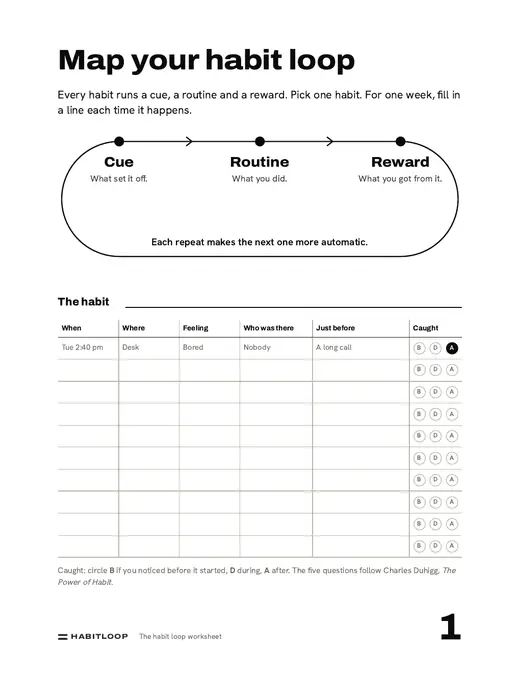
Every habit runs the same three steps: a cue, a routine and a reward. Repeat them enough and the routine starts without you.
- CueA time, a place, a feeling.
- RoutineWhat you do.
- RewardWhat you get from it.
Each repeat makes the next one more automatic.
What the habit loop is.
A habit loop is a behavior your brain has learned to run as one piece. Something sets it off: the cue. You do the thing: the routine. You get something for it: the reward. The reward teaches your brain to run the routine the next time the cue shows up.
Charles Duhigg gave the loop its name in The Power of Habit in 2012.1 The brain research came first. In 1999, Ann Graybiel's lab at MIT recorded from the brains of rats as they learned a maze. As the run turned into a habit, activity in a region called the striatum came to mark the start of the run and the end of it.2 The whole routine had become one unit.
Three versions of the same loop.
| Who | The steps |
|---|---|
| Charles Duhigg, The Power of Habit | Cue, routine, reward1 |
| James Clear, Atomic Habits | Cue, craving, response, reward3 |
| Judson Brewer, psychiatrist | Trigger, behavior, reward4 |
They describe one thing. Something starts it, you act, and it pays off.
Why you don't notice it running.
A habit is what you do while you think about something else. In two diary studies, students reported every hour what they were doing and what they were thinking. Between a third and a half of what they did was habit: done almost every day, usually in the same place. In the first study, their thoughts were somewhere else during 60% of those habits.5
That's the hard part of breaking one. The loop is often finished before you know it started.
The habit loop in nail biting, hair pulling and skin picking.
- CueA rough edge. A slow call.
- BiteFingers to teeth.
- PayoffA smooth edge. Less tension.
Nail biting. The cue is small: a rough edge, a dull meeting. The payoff is a smooth edge and a little less tension. How to stop biting your nails.
Hair pulling. The routine is a chain. Fingers reach the scalp or brow, search for a certain feel, find it, and pull. The touch and the search are the earliest points you can act on. How to stop pulling your hair.
Skin picking. This loop feeds itself. Fingers scan, find a rough spot and pick it smooth. The spot scabs over, and the scab is the next rough spot. How to stop picking your skin.
How to break a habit loop.
- Find the cue. For one week, write down each time it happens: where you were, what you were doing, how you felt. The pattern shows up fast.
- Catch the routine as it starts. You can't change a routine you don't notice. Most advice skips this step.
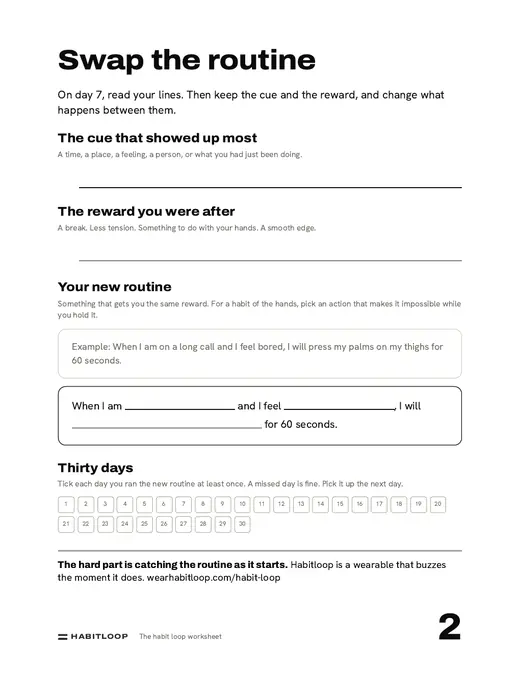
- Swap the routine. Keep the cue and the reward. Change what happens between them.1 For a habit of the hands, pick an action that makes it impossible while you hold it: fists at your sides, or palms pressed to your thighs. Hold for one to three minutes.
- Repeat. In one study, 96 people took up a new daily habit. The time it took to become automatic ranged from 18 to 254 days. Missing one day made no real difference.6
Steps two and three are the core of habit reversal training, first described in 19737 and still the most studied behavioral method for nail biting, hair pulling and skin picking.8
Print the worksheet.
Two pages. Map one habit's loop for a week, then plan the swap. Free, no email.
Break the loop.
Step two is the one you can't do by trying harder, because the loop runs while your attention is somewhere else. Habitloop is a wearable that detects the habit as it starts and buzzes your wrist. One buzz. Your hand stops. What you do next is yours.
Questions.
What are the three parts of the habit loop?
A cue, a routine and a reward. The cue starts it, the routine is what you do, and the reward is why your brain keeps it.
What are the four stages of the habit loop?
James Clear's version has four: cue, craving, response and reward. The craving is the wanting that sits between the cue and what you do.3
Who came up with the habit loop?
Charles Duhigg named it in The Power of Habit in 2012, building on brain research like the MIT maze study above.1,2
How long does it take to break a habit loop?
There is no fixed number. A replacement routine is a new habit, and in the study above a new habit took anywhere from 18 to 254 days to become automatic.6
More: why you can't just stop, every fix, compared, the habits Habitloop catches.
Sources
- Charles Duhigg, The Power of Habit: Why We Do What We Do in Life and Business, Random House, 2012.
- Jog, Kubota, Connolly, Hillegaart and Graybiel, Building neural representations of habits, Science 286(5445), 1999.
- James Clear, How to start new habits that actually stick, from Atomic Habits, 2018.
- Judson Brewer, The habit loop.
- Wood, Quinn and Kashy, Habits in everyday life: thought, emotion, and action, Journal of Personality and Social Psychology 83(6), 2002. Habits were 35% of behaviors in the first study and 43% in the second.
- Lally, van Jaarsveld, Potts and Wardle, How are habits formed: modelling habit formation in the real world, European Journal of Social Psychology 40(6), 2010. Automatic here means 95% of each person's own ceiling.
- Azrin and Nunn, Habit-reversal: a method of eliminating nervous habits and tics, Behaviour Research and Therapy 11(4), 1973.
- TLC Foundation for Body-Focused Repetitive Behaviors, Expert Consensus Treatment Guidelines, 2016.